Weaving techniques and elements
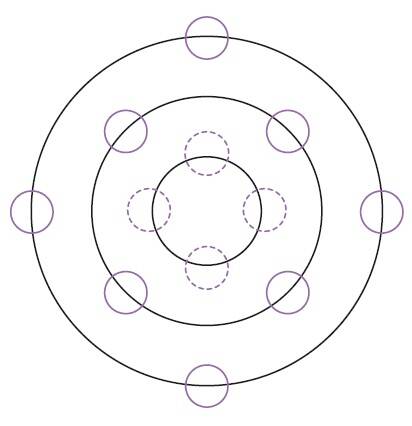
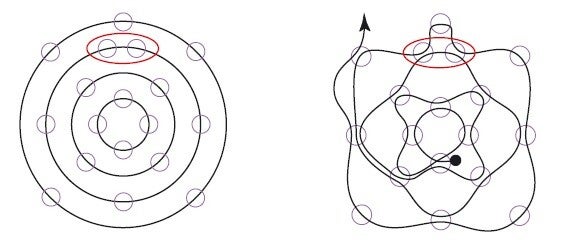
The designation of uncolored beads with a dotted outline is a conditional symbol used in the diagrams to indicate beads of an already woven row. These rows are shown for self-checking the accuracy of the weaving and to help with transitioning from one diagram to another, without overloading or excessively reducing the diagrams.
Mosaic weaving
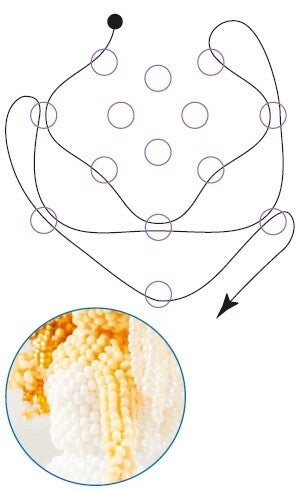
Mosaic weaving is characterized by a dense arrangement of beads and resembles a mosaic, which is how the technique gets its name. In our posts, it is the main weaving technique, as the finished parts woven in this way have good stiffness and hold their shape well.

Adding Beads
To add the required number of beads within the fabric, weave two beads instead of one at the specified point. In the next row, an additional bead will be placed between them. As a result, the number of beads in the row is increased by one.
Decreasing Beads
Reductions are made using the same principle as increases, but in reverse order. Two beads are taken together, and in the next row one bead is woven above them. A reduction may also be made by not adding a bead, passing the thread between neighboring beads only. Increases and reductions may be used several times within a single row to achieve the desired shape of the element.

Expansion
An expansion is made when two beads are woven instead of one. Unlike an increase, an expansion does not change the number of beads in the row, as the two beads replace a single bead.

Monastic weaving
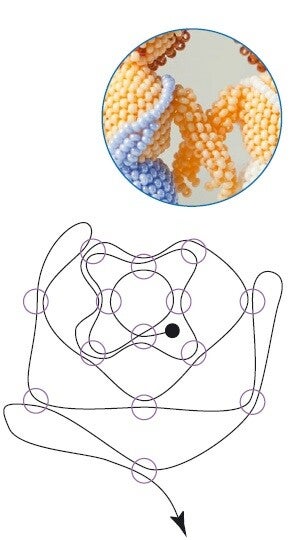
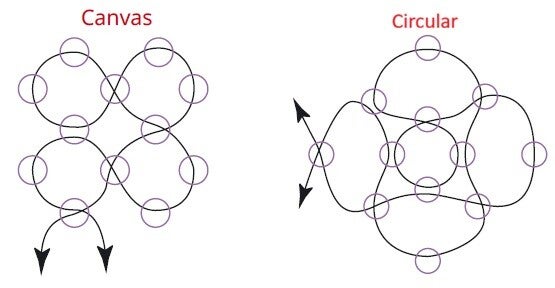
Monastic weaving is a technique in which the beads are arranged at a 90-degree angle to each other, forming crosses. As a result, a mesh-like fabric is created. Elements made using this technique are very flexible, which makes monastic weaving suitable for creating curved parts such as horns and tails. Due to its geometric structure, it is also often used for square shapes.
In our posts, monastic weaving is used both for creating a flat fabric and in circular weaving. Work is done on fishing line with needles at both ends.
In some diagrams, the monastic crosses are marked with numbers indicating the row number and its beginning. Each cross normally consists of four beads; however, when increases or reductions are introduced, a cross consists of five beads.
Decreasing Beads
A decrease in monastic weaving is made by capturing two upper beads instead of one. As a result, a monastic cross consisting of five beads is formed.
Expansion
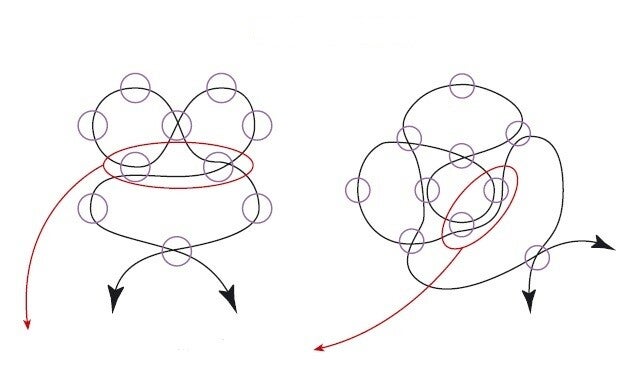
An expansion does not increase the number of crosses in a row. It is used to create smooth, rounded shaping at the required point by replacing one bead with two. Unlike an increase, the two beads in an expansion are not woven as independent crosses.

Brick weaving
Brick weaving can be compared to a brick wall, as the beads are arranged in an offset pattern. For the most accurate result, it is recommended to use even, calibrated TOHO beads. In our posts, this technique is mainly used for creating wings and fins.

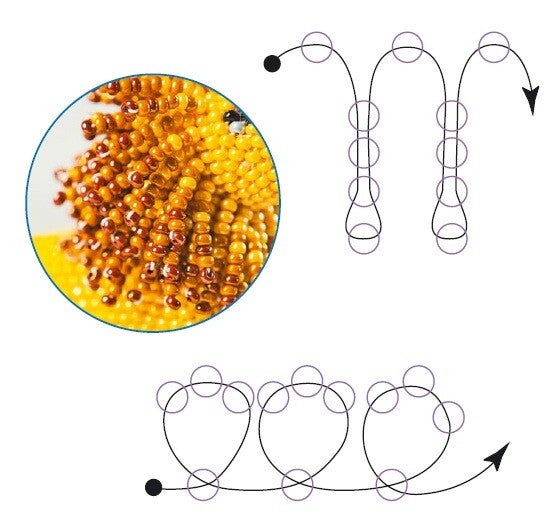
Needle weaving, "beaded fur"
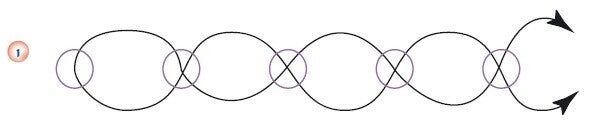
Needle weaving is the simplest technique. Several beads are strung onto the thread (fishing line), after which the last bead is skipped and the thread is passed back through the remaining beads, tightening the work. As a result, the beads lie flat, forming a “needle.”
In this pattern, needle weaving is used for decorative elements such as hair, fingers, combs, feathers, and claws.
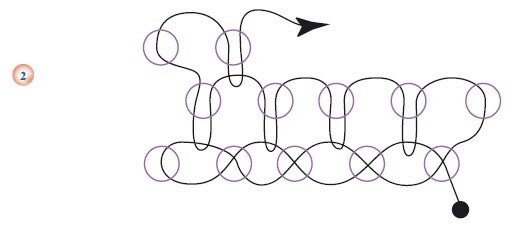
Ndebele Technique
The finished work created using the Ndebele technique resembles a braid or an ear of corn. It is used for creating decorative elements in figurines, such as ears of corn and arrows. The technique originates from the Ndebele tribe of South Africa, whose women have used it for over 200 years. The bead arrangement resembles a “Christmas tree” pattern in knitted fabric.
To begin, string two beads onto the thread and pass the needle through the first bead to form a ring. Next, add two more beads, insert the needle into the second bead of the first row, and exit through the second bead of the second row. Continue by stringing two beads, passing the thread through the first bead of the previous row, and returning it through the second bead of the new row.
In our posts, the Ndebele technique is used only in the form of a direct Ndebele rope.
Decrease for edges
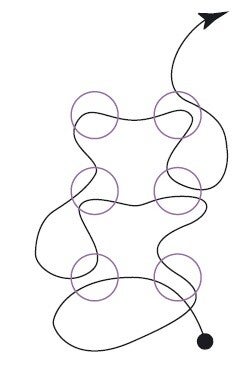
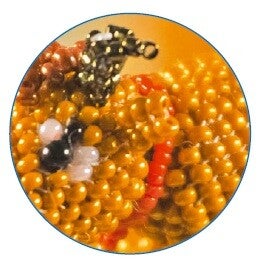
This technique is the same as a standard mosaic decrease, but it does not close or narrow the row. It is used when creating limbs, necks, and bodies to form the basis of a curve. Decreasing at the angle or along the edge of mosaic fabric is convenient for shaping the bases of arms, paws, and necks.
To perform this decrease, continue weaving the row to the specified point in the diagram without weaving the last bead of the row. Return the thread to the last bead added and continue weaving in the opposite direction. In the same way, turn the direction of weaving before reaching the end on the opposite side. By gradually reducing the number of beads woven from each edge, a neat corner is formed.
Strap (bend)
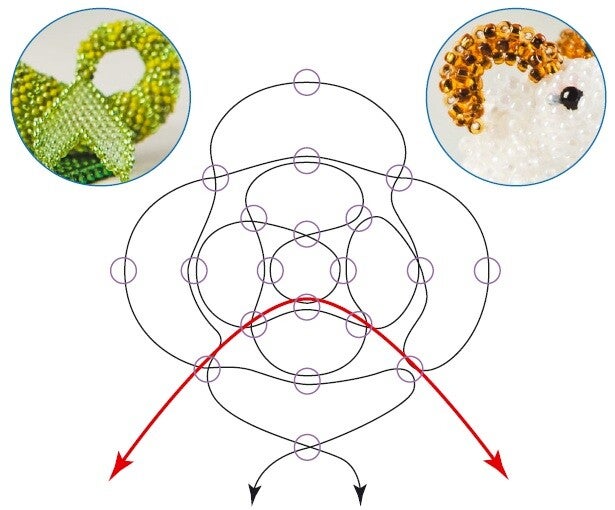
This technique is used only in monastic weaving. A strap (bend) is created by pulling together parallel beads using fishing line, followed by fixation to form a controlled bend. In the diagrams, the tightening points are marked with a red arc with arrows on both sides.
Work is done with a thread fitted with two needles. Pass one end of the thread through the central upper vertical bead, then pass both ends through the horizontal beads on each side, moving toward the specified lower vertical bead, where the two ends of the fishing line meet.
At this stage, tie a single knot and gradually tighten the fishing line. As the tension increases, a bend forms in the element.